
7 Best Propane Garage Heaters for Warm Workshops
Choosing the right propane garage heater can mean the difference between a chilly, damp workspace and a warm, comfortable zone where you can tinker on projects, defrost a car, or simply relax after a long day. With countless models promising efficiency, safety, and rugged durability, it’s easy to feel overwhelmed by the options and uncertain which unit will truly meet the unique demands of a garage environment. In this post we’ll cut through the hype by reviewing the top seven propane garage heaters on the market, highlighting their key features, performance metrics, and price points so you can make an informed decision. Read on to discover the best fit for your garage.
Best Propane Garage Heaters for Warm Workshops
We’ve tested dozens, and these seven models consistently deliver reliable heat, safety features, and energy efficiency for any garage.
7. Gasland MHA18BN Propane Heater

The Gasland MHA18BN is a compact, portable propane radiant heater that delivers up to 18,000 BTU, comfortably warming areas as large as 450 sq ft. Its sleek cabinet houses a 20 lb LP cylinder, keeping the fuel out of sight while the built‑in rolling wheels and Easy‑Carry handle let you move it from a garage to a workshop in seconds. The heater operates on propane alone, so you stay warm even when the power goes out, cutting electricity costs and eliminating tripping hazards. Three adjustable heat settings (High/Medium/Low) let you fine‑tune the output, while the ultra‑quiet design creates a peaceful environment for reading, working, or social gatherings. Safety is front‑and‑center with Tip‑Over and Low‑Oxygen Shut‑off sensors that automatically shut the unit down if it’s knocked over or the air becomes unsafe.
Pros
- Safety‑first features: tip‑over and low‑oxygen shut‑off protect users and property.
- Energy‑independent: no electricity needed, reducing utility bills and ensuring heat during outages.
- Portable & space‑saving: wheels, handle, and hidden tank make relocation and storage effortless.
Cons
- Requires a 20 lb propane cylinder, which may be less convenient than electric models for indoor use.
- Best suited for well‑ventilated spaces; improper ventilation can lead to carbon monoxide buildup.
6. Westinghouse iGen2200 Portable Propane Forced Air Heater

The Portable Propane Forced Air Heater delivers reliable, high‑output warmth wherever you need it. With a robust 125,000 BTU/hr output, it can comfortably heat spaces up to 3,125 sq ft—perfect for workshops, garages, or outdoor events. Powered by a standard 40‑lb. propane tank, the unit runs up to 11.5 hours on a single fill, and its variable‑rate control lets you fine‑tune the temperature for optimal comfort and fuel efficiency.
Key Features
– 125,000 BTU/hr heat output
– Covers up to 3,125 sq ft of space
– Operates continuously for up to 11.5 hours
– Requires a minimum 40‑lb. propane tank
– Variable‑rate thermostat for precise temperature control
Pros
- Powerful coverage: One heater handles large areas, reducing the need for multiple units.
- Long run time: Extended operation means fewer refuel stops during prolonged jobs.
- Adjustable output: Variable rate lets you conserve propane while maintaining comfort.
Cons
- Tank size requirement: Needs a 40‑lb. tank, which may be bulkier than smaller portable heaters.
- Fuel dependency: Propane consumption can be high at maximum output, so monitor usage in remote locations.
5. 80000 BTU Portable Propane Heater

The 80000 BTU Portable Propane Heater delivers powerful, convection‑based warmth for large garages, workshops, and outdoor work sites. With an adjustable output ranging from 30,000 BTU to 80,000 BTU, it can comfortably heat up to 2,000 sq ft—perfect for spacious areas where traditional space heaters fall short. The unit comes complete with a 10‑foot hose, regulator, and P.O.L. tank connection, allowing you to hook up a 100 lb. propane tank and enjoy up to 14 hours of continuous heat on a single fill. Safety is built‑in: a piezo push‑button igniter, a standing pilot that prevents tip‑overs, and an automatic shut‑off when flame loss is detected. Its 360‑degree heat output circulates warm air evenly, while the clean‑burning propane engine runs without electricity, making it ideal for off‑grid or power‑outage scenarios. The heater is CSA certified, ensuring it meets rigorous safety standards.
Pros
- High heat capacity (30‑80 kBTU) covers large spaces up to 2,000 sq ft.
- Long runtime (up to 14 hrs) on a standard 100 lb. propane tank.
- Built‑in safety features: standing pilot, flame‑loss shut‑off, tip‑over protection.
Cons
- Requires a propane tank and proper ventilation; not suited for enclosed, airtight rooms.
- Weight and size make it less portable for frequent moving; best used in semi‑fixed locations.
4. Baotree 60,000 BTU Forced Air Propane Heater

The Baotree 60,000 BTU Forced‑Air Propane Heater is a rugged, portable solution for heating large workspaces. With a variable output of 40,000–60,000 BTU, it can comfortably warm areas up to 2,497 sq ft (≈232 m²)—perfect for a one‑to‑six‑car garage, construction site, or outdoor patio. The heavy‑duty forced‑air fan delivers a noticeable temperature rise in under 10 minutes, while the adjustable nozzle (30–45°) lets you direct airflow exactly where it’s needed. Safety is built‑in: pulse ignition prevents flame‑outs and gas leaks, and over‑heat protection shuts the unit off automatically during power loss. Set‑up is straightforward—plug into a standard 115 V outlet, attach the included 10‑ft hose and regulator to a 20‑lb (≈9 kg) propane tank, and you’re ready to go. A sturdy handle and adjustable height make relocation effortless, and the compact design fits tight spaces without sacrificing power.
Pros
- High, adjustable heat output covers large areas quickly.
- Rapid, even heating thanks to the powerful forced‑air fan and swivel nozzle.
- Built‑in safety features (pulse ignition, over‑heat shut‑off) give peace of mind on any job site.
Cons
- The unit produces a noticeable humming noise during operation, which may be a concern in quiet environments.
- Requires a 20‑lb (or larger) propane tank, so it’s less convenient for locations without easy tank access.
3. Baotree 12,500 BTU Forced Air Propane Heater

The Baotree 12,500 BTU forced‑air propane heater is built for rugged, on‑the‑go heating. With a variable output of 95,000‑125,000 BTU, it can comfortably warm up to 2,497 sq ft (≈232 m²)—perfect for a 1‑ to 6‑car garage, construction site, or outdoor workshop. The heavy‑duty fan pushes warm air through a 10‑ft hose and a 30‑45° adjustable nozzle, delivering a noticeable temperature rise in under 10 minutes. Plug it into any standard 115‑V outlet, attach the hose and regulator to a 20‑lb (or larger) propane tank, and the pulse‑ignition system starts the flame safely and reliably. Overheat protection automatically shuts the unit off during power loss, and a sturdy carry handle with height‑adjustable legs makes relocation a breeze.
The heater comes with a 10‑ft hose, regulator, and clear safety instructions: tighten connections with a wrench to prevent leaks, and expect a modest operational noise level.
Pros
- Fast, even heat – heavy‑duty fan + adjustable nozzle covers large areas quickly.
- Portable & versatile – handle, height adjustment, and 10‑ft hose suit garages, yards, and job sites.
- Safe ignition & shut‑off – pulse ignition, overheat protection, and leak‑prevention guidance.
Cons
- Noise level – the fan generates a noticeable hum during operation.
- Requires 115 V outlet – limited to locations with accessible power sources.
2. Habitio 125,000 BTU Forced Air Propane Heater
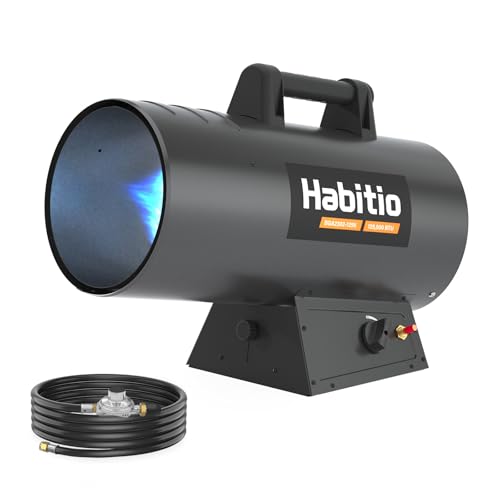
The Habitio 125,000 BTU Forced‑Air Propane Heater is a rugged, portable torpedo‑style unit built for job sites, garages, and large‑area workspaces. With a heating output ranging from 75,000 – 125,000 BTU/h, it can comfortably cover up to 3,125 sq ft, delivering rapid warmth in even the coldest environments. The heater arrives with a 10‑ft hose and regulator, and a sturdy carry handle plus height‑adjustment lever make positioning effortless. Pulse‑ignition starts the unit safely without a spark plug, while built‑in overheat protection and an automatic shut‑off during power loss keep it CSA‑certified and reliable. High‑efficiency thermal conversion ensures complete propane combustion, reducing fuel waste and extending run‑time—up to 28 hours on low or 17 hours on high with a 100‑lb tank (tank not included). Adjustable fan speeds let you fine‑tune airflow for quick heat‑up or steady temperature maintenance, and the robust metal housing resists corrosion and shock on rough sites.
Pros
- Powerful coverage – 75,000–125,000 BTU/h heats up to 3,125 sq ft quickly.
- Safety‑first design – pulse ignition, overheat protection, automatic shutdown, and CSA certification.
- Long run‑time & fuel efficiency – up to 28 hrs on low with a standard 100 lb propane tank.
Cons
- Noise level – the unit generates noticeable operational noise, which may be distracting in quiet settings.
- Installation step – the gas connection must be tightened with a wrench after attachment, adding a small setup step.
1. Habitio 60,000 BTU Forced Air Propane Heater

The Habitio 60,000 BTU Forced‑Air Propane Heater is a rugged torpedo‑style unit built for job sites, garages, and large‑area workspaces. With a heating output of 40,000–60,000 BTU/h, it can comfortably cover up to 2,195 sq ft, delivering rapid warmth in cold environments. The heater comes with a 10‑ft hose and regulator, a portable handle, and an adjustable‑height frame, making placement on patios, factories, or construction zones quick and hassle‑free.
Installation is straightforward: after attaching the gas pipe, simply tighten it with a wrench (see note ①). The unit does generate a modest operational noise (note ②), which is typical for high‑capacity forced‑air heaters. Safety is front‑and‑center—pulse ignition eliminates flame‑outs, over‑heat protection shuts the unit down automatically, and CSA certification guarantees compliance with industry standards. High‑efficiency thermal conversion ensures full propane combustion, while the corrosion‑ and shock‑resistant housing stands up to tough site conditions. On a 100 lb. propane tank, the heater runs 53 hrs on low and 36 hrs on high, with fan‑speed controls for precise temperature management.
Pros
- Powerful coverage – heats up to 2,195 sq ft quickly.
- Safe & certified – pulse ignition, over‑heat shutoff, CSA approval.
- Long runtime & adjustable fan – up to 53 hrs on low with easy temperature control.
Cons
- Noise level – produces a noticeable hum during operation.
- Propane tank not included – requires separate purchase of a suitable tank.
Buying Guide
When choosing a propane garage heater, focus on heating capacity, safety features, and energy efficiency to keep your workspace warm without excess fuel consumption.
- BTU Output & Coverage Area – Ensure the heater’s BTU rating matches the size of your garage; a unit rated for 15,000‑20,000 BTU typically covers 500‑800 sq ft efficiently.
- Safety Controls – Look for automatic shut‑off, tip‑over protection, and oxygen depletion sensors, which prevent fire hazards and carbon‑monoxide buildup.
- Build Quality & Materials – Heavy‑gauge steel housing and corrosion‑resistant finishes extend lifespan, especially in damp or dusty garage environments.
- Fuel Efficiency & Adjustable Thermostat – Models with modulating burners and precise thermostats use propane more sparingly while maintaining a consistent temperature.
- Customer Reviews & Warranty – Prioritize heaters with strong user feedback and at least a one‑year warranty, indicating reliable performance and manufacturer support.
By weighing these factors—capacity, safety, durability, efficiency, and proven reliability—you’ll select a propane garage heater that delivers steady warmth and long‑term value. Regular maintenance, such as cleaning the burner and checking connections, will keep the unit performing at its best.
Frequently Asked Questions
What factors determine the best propane garage heater for my space?
Answer:
– BTU rating: Choose a heater that matches the garage’s square footage (roughly 30–40 BTU per square foot).
– Safety features: Look for automatic shut‑off, tip‑over protection, and oxygen depletion sensors (ODS).
– Ventilation needs: Vent‑free models require good airflow; vented units need a chimney or exhaust pipe.
– Portability vs. permanent installation: Portable units are easy to move, while wall‑mounted heaters provide consistent heat.
– Noise level: Low‑decibel fans are preferable if you work or store noise‑sensitive items.
How much propane will a typical garage heater use, and how can I estimate runtime?
Answer:
– A 20,000‑BTU heater consumes about 0.5 lb of propane per hour at full output.
– To estimate runtime:
1. Determine the heater’s BTU rating.
2. Divide the BTU rating by 91,500 BTU (the energy in one pound of propane).
3. Multiply the result by the heater’s operating hours.
– Example: A 30,000‑BTU unit on medium (≈75 % capacity) uses ~0.26 lb/hr; a standard 20‑lb tank would last roughly 75 hours at that setting.
Is it safe to run a propane heater in an attached garage, and what precautions are required?
Answer:
– Yes, if proper safety measures are followed:
– Install an oxygen depletion sensor (ODS) that shuts the heater off when O₂ levels drop below 18 %.
– Ensure adequate ventilation (open a door or window, or use an exhaust fan).
– Keep the heater away from flammable materials and never leave it unattended while running.
– Use a carbon monoxide detector in both the garage and the adjoining living space.
– Never use a heater designed for outdoor use only inside an enclosed garage, as it may produce excessive carbon monoxide.
– Follow the manufacturer’s installation and maintenance guidelines to maintain safe operation.
Conclusion
Choosing the right propane garage heater ultimately comes down to matching heat output to your space, prioritizing safety features, and considering long‑term operating costs. A well‑sized unit will warm the area efficiently without overworking the system, while built‑in thermostats, tip‑over protection, and proper ventilation keep the environment secure. Energy‑efficient models reduce fuel consumption and lower your bills, and easy‑access controls make daily use straightforward. By weighing these factors—capacity, safety, efficiency, and convenience—you can invest in a heater that delivers reliable warmth throughout the colder months, protecting both your vehicle and your garage workspace, and ensuring consistent performance year after year.