
7 Best Pull‑Down Attic Stairs for Easy Home Access
Choosing the right pull‑down attic stairs isn’t just about convenience—it’s a safety upgrade, a space‑saving solution, and a way to protect your home’s insulation from damage caused by clumsy, makeshift ladders. A sturdy, easy‑to‑operate stair system can turn a cramped, hard‑to‑reach storage area into a tidy, accessible space, while also preventing costly accidents and wear on your flooring. In this post we’ll cut through the clutter of options and review the top 7 best pull‑down attic stairs on the market, highlighting key features, durability, and price points so you can pick the perfect fit for your needs. Let’s dive into the selections and find the ideal stairway for your attic.
Must-Have Pull-Down Attic Stairs for Every Home
We’ve tested dozens of models, and these seven standout for durability, ease of installation, and smooth operation in any attic space.
7. Aluminum Attic Ladder – Retractable Stairs

The Aluminum Attic Ladder combines a sleek, retractable design with robust construction, making loft access effortless for homes with ceiling heights between 7’8″‑10’3″. When you pull the ladder down, the heavy‑duty hinges and widened, non‑slip steps unfold smoothly, while the integrated handrail adds an extra layer of security. After use, simply fold the ladder back into its compact 22.5″ × 54″ footprint and tuck it away, freeing up valuable floor space. Crafted from high‑quality aluminum alloy, this ladder supports up to 375 lb, resisting dents and corrosion for long‑term reliability. Whether you’re storing seasonal items or performing routine maintenance, the ladder’s sturdy footing and stable operation keep you confident on every climb. Need help? Our 24/7 support team is ready to answer any questions.
Pros
- Space‑saving retractable/folding design – easy pull‑down access, folds flat for storage.
- Strong and safe – 375 lb capacity, heavy‑duty hinges, widened non‑slip steps, and handrail.
- Versatile fit – works with ceiling heights from 7’8″ to 10’3″, ideal for most residential lofts.
Cons
- Manual lifting – requires physical effort to pull down and fold back; not motorized.
- Limited to specified ceiling heights – must verify your ceiling falls within the 7’8″‑10’3″ range before purchase.
6. Dura Lok AL-10

The 10‑foot aluminium attic ladder is engineered for strength and convenience. Constructed from high‑strength aluminium, it supports up to 350 lb while remaining lightweight enough for easy installation in garages, sheds, or outdoor attic entries. Its non‑slip 3‑inch foot mats on every rung and integrated handrails give you a secure, comfortable climb, and the heavy‑duty hinges keep the ladder steady even when hauling bulky items. Designed for openings of 54 in W × 22.5 in H, it fits ceiling heights from 7′ 8″ to 10′ 3″ and folds flat into the ceiling, freeing up floor space. The smooth, quiet opening and closing mechanism lets you access the attic with minimal noise, while full compliance with ANSI 14.9 standards guarantees industry‑leading safety and reliability.
Pros
- High load capacity (350 lb) and durable aluminium construction for long‑lasting performance in wet or extreme conditions.
- Enhanced safety with non‑slip foot mats, handrails, and sturdy hinges, ideal for frequent use and moving large items.
- Space‑saving design that folds into the ceiling and fits a wide range of ceiling heights, keeping rooms tidy.
Cons
- The 10‑foot length may be excessive for low‑ceiling spaces, requiring careful measurement before purchase.
- Installation involves cutting a relatively large opening (54 × 22.5 in), which may need professional help for finished ceilings.
5. VEVOR Attic Ladder 375LBS

The VEVOR Attic Ladder is a versatile, fold‑able aluminum stair system designed to give you safe, hassle‑free access to any attic space. It fits ceiling heights from 7.66 ft to 10.3 ft thanks to two detachable steps and a simple trim‑to‑size option. Installation is straightforward: cut a 54 × 22.5 in opening (depth ≥ 4.3 in), drill, lift, and screw the ladder into a load‑bearing area. The anti‑slip adjustable feet adapt to hardwood, tile, or carpet, while the magnetic door panel blends the ladder seamlessly with your ceiling.
Smooth, controlled lowering is provided by upgraded dual‑side hydraulic rods, eliminating sudden drops and reducing the effort needed to open or close the ladder—perfect for seniors or anyone with limited strength. A pull rod and ring let you operate the ladder without climbing onto it, and the heavy‑duty hinges, 3.1‑inch wide steps, and 375 lb load capacity ensure two adults can work safely side‑by‑side. Constructed from corrosion‑resistant aluminum alloy, the ladder is built for long‑term use in storage rooms, balconies, rooftops, or lofts. When folded, it measures just 53.9 × 22.4 × 9.2 in, saving valuable floor space.
Pros
- Adjustable height range and detachable steps accommodate most residential ceiling heights.
- Dual hydraulic rods give a slow, steady descent, enhancing safety and ease of use.
- Strong 375 lb capacity and wide steps support two adults simultaneously.
Cons
- Requires a load‑bearing mounting point; not suitable for non‑structural ceiling areas.
- The 54 × 22.5 in opening may be larger than some existing attic hatch openings, necessitating additional framing work.
4. AP2240MS LITE Attic Ladder

The LITE 10‑Foot Aluminium Attic Ladder (AP2240MS) is built for homeowners who need a reliable, space‑saving way to reach the attic. Its aluminum frame is “tough as nails,” resisting rust and wear while staying lightweight enough for one‑person setup. The ladder fits a rough opening of 54 in W × 22.5 in H, making it ideal for standard roof‑line cutouts. Designed for ceiling heights from 7 ft 8 in to 10 ft 3 in, it extends to a full 10 ft when fully deployed, giving you comfortable headroom inside the loft.
Safety is front‑and‑center: the ladder supports up to 375 lb (Type IAA rating), and heavy‑duty hinges lock the rungs in place, eliminating wobble. Each step features a slip‑resistant cross‑tread with a generous 3.25‑in depth, so you can ascend and descend with confidence, even in socks or work boots. Whether you’re storing seasonal items or performing routine maintenance, this ladder offers sturdy, hassle‑free access without sacrificing attic space.
Pros
- Durable aluminum construction resists corrosion and stands up to frequent use.
- High load capacity (375 lb) with secure hinges for wobble‑free climbing.
- Slip‑resistant, deep steps provide stable footing on a variety of footwear.
Cons
- The 54 in width may be too wide for very tight attic openings.
- Aluminum can feel less “solid” compared to steel ladders for users who prefer a heavier feel.
3. GarageTrac GT-220
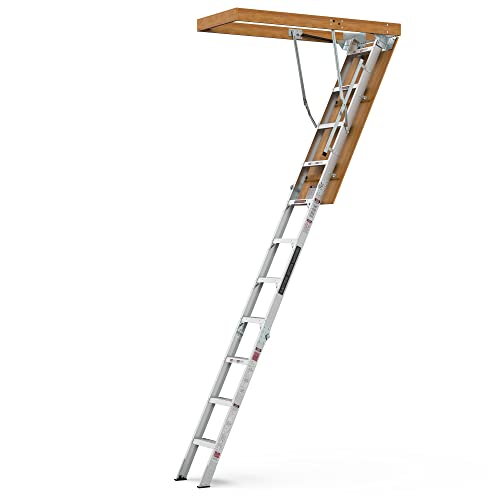
The Aluminum Attic Ladder combines rugged durability with space‑saving convenience. Constructed from high‑quality aluminum, the ladder supports up to 380 lb without flexing, making it ideal for heavy loads and frequent use. Its retractable, folding design lets you pull the stairs down in seconds, then fold them flat against the ceiling when not needed, freeing valuable floor space. Engineered for ceiling heights ranging from 7’ 8″ to 10’ 3″, it fits a wide variety of homes and lofts. Heavy‑duty hinges and a sturdy handrail keep the ladder stable, while non‑slip treads give each step confident traction. The opening and closing mechanisms glide smoothly and quietly, so you won’t disturb the household while accessing the attic.
Pros
- Strong aluminum build – 380 lb capacity and corrosion‑resistant for long‑term use.
- Space‑efficient folding – pulls down quickly, folds flat to save room.
- Safety‑focused features – heavy‑duty hinges, handrail, and non‑slip treads prevent wobble and slips.
Cons
- Limited to ceiling heights between 7’ 8″ and 10’ 3″; may not fit very low or very high attics.
- Installation may require basic carpentry tools and skills, which could be a hurdle for DIY beginners.
2. Vantic 10 Foot Aluminum Attic Ladder

The Vantic 10‑Foot Aluminum Attic Ladder Pull‑Down System is engineered for homes with a 22½″ × 54″ rough opening and ceiling heights ranging from 7′ 8″ to 10′ 3″. Its solid pine side rails and reinforced plywood base give the ladder a sturdier feel than the typical MDF alternatives, while the lightweight aluminum frame and heavy‑duty hinges keep the unit easy to operate. An upgraded gas‑assist rod, diagonal stabilizing bars, and non‑slip feet deliver a smooth, wobble‑free descent, and the 3″ slip‑resistant steps meet ANSI 14.9 safety standards. With a 350 lb load capacity, this fold‑away loft ladder is ready for heavy‑duty use, making attic access safe and comfortable for anyone.
Pros
- Robust construction – pine rails + reinforced plywood base outperform MDF for durability.
- Smooth, secure operation – gas rod, stabilizing bars, and non‑slip feet prevent wobble and ensure steady footing.
- Heavy‑duty capacity – supports up to 350 lb while complying with ANSI safety standards.
Cons
- Precise opening required – must match the 22.5″ × 54″ rough opening; inaccurate measurements can cause fit issues.
- Limited ceiling height range – only suitable for ceilings between 7′ 8″ and 10′ 3″, so not ideal for very low or very high attics.
1. AluFold Attic Ladder, 22.5″ x 54

The Aluminum Attic Ladder is engineered for effortless access to loft spaces with ceilings ranging from 7’8″ to 10’3″. Its retractable, folding design lets you pull the stairs down in seconds, then tuck them away compactly when not in use—perfect for saving precious storage space. Constructed from high‑quality aluminum alloy, the ladder supports up to 375 lb, offering a sturdy, corrosion‑resistant solution that stands up to daily use. Heavy‑duty hinges, non‑slip footings, and widened steps provide a stable platform, while the integrated handrail adds an extra layer of safety for every climb. Whether you’re hauling boxes, cleaning, or installing insulation, this ladder makes reaching the attic quick and secure.
Pros
- Universal fit for most residential ceiling heights (7’8″–10’3″).
- Space‑saving design: folds to a compact 22½” × 54″ profile.
- Robust safety features: heavy‑duty hinges, non‑slip footings, widened steps, and handrail.
Cons
- Manual pulling mechanism may require a bit of effort for heavier users.
- Fixed ladder length; not adjustable beyond the specified ceiling range.
Buying Guide
Choosing the right pull‑down attic stairs hinges on safety, ease of use, and long‑term reliability. Look for models that combine sturdy construction with smooth operation to protect both the home and its occupants.
- Load capacity and material quality – Ensure the stair can support the advertised weight limit and is built from solid wood or reinforced steel for strength.
- Installation and space requirements – Verify that the kit fits your ceiling opening and that the mounting hardware allows a straightforward, tool‑minimal installation.
- Safety features – Look for handrails, anti‑slip treads, and a secure locking mechanism that keeps the stairs firmly in place when lowered.
- Durability and warranty – Choose a product with a corrosion‑resistant finish and a multi‑year warranty to guard against wear.
- Customer reviews and value – Compare real‑world feedback and price points to gauge overall satisfaction and cost‑effectiveness.
By weighing these factors, you can select a pull‑down attic stair that offers safe access, lasting performance, and the best value for your home.
Frequently Asked Questions
What features should I look for in the best pull‑down attic stairs?
- Weight capacity – Choose a model rated for at least 250 lb (preferably 300 lb) to safely support the ladder and any tools you’ll carry.
- Ease of operation – Look for a smooth, spring‑assisted or counter‑balanced mechanism that opens and closes with minimal effort.
- Insulation and sealing – A stairwell with insulated panels and weather‑stripping helps prevent heat loss and keeps drafts out.
- Durable materials – Aluminum or reinforced steel frames resist corrosion and wear, while a solid wood tread adds stability.
- Safety accessories – Handrails, non‑slip treads, and a built‑in latch or lock are essential for safe, secure use.
How do I properly install a pull‑down attic stair kit?
- Measure the opening – Verify the rough opening (usually 22” × 30”) matches the kit’s specifications.
- Cut the opening – Use a reciprocating saw or circular saw to cut the drywall and framing, then frame the opening with 2×4 lumber.
- Attach the frame – Secure the stair’s frame to the joists with the supplied lag bolts; pre‑drill pilot holes to avoid splitting wood.
- Install the ladder – Hang the ladder on the pivot brackets, ensuring it sits level and moves freely.
- Seal and finish – Apply insulation, install the attic door panel, and add trim or paint for a clean look.
- Test the mechanism – Open and close the stairs several times, checking for smooth operation and proper alignment.
(Always follow the manufacturer’s instructions and local building codes; consider hiring a professional if you’re unsure about structural work.)
Which pull‑down attic stairs provide the best value for homeowners?
- Lowe’s “Attic Ladder Kit – 30‑in. Wide” – Affordable, easy to install, and includes a sturdy aluminum frame with a non‑slip tread.
- Rockler “Heavy‑Duty Attic Ladder” – Higher weight rating (300 lb), reinforced steel construction, and a smooth spring‑assist mechanism; ideal for frequent use.
- IKEA “STUVA / HEMNES Attic Ladder” – A budget‑friendly option with a minimalist wood finish, suitable for light‑duty access and decorative spaces.
All three models meet standard building code requirements, but the best choice depends on your budget, expected load, and aesthetic preferences. Reading user reviews and checking warranty terms can also help you decide.
Conclusion
Choosing the right pull‑down attic stairs transforms a cramped, hard‑to‑reach space into a convenient, safe storage area, and the review process shows that durability, weight capacity, and smooth operation are the most decisive factors. A well‑designed model should blend seamlessly with your home’s décor, require minimal installation effort, and include reliable safety features such as locking mechanisms and sturdy handrails. Balancing price against long‑term performance ensures you get value without compromising on quality. By prioritizing these criteria, you can confidently select a stair system that enhances accessibility, protects your belongings, and stands up to years of regular use.